STATISTICAL ANALYSIS · BEGINNER GUIDE
Statistical Analysis with Missing Data: A Practical Checklist
Classify missing values, inspect why records are absent and report the handling method before drawing conclusions.
Quick answer: Do not begin by deleting every row with a blank. First find which values are missing, why they may be missing and whether missingness differs across people or outcomes. The right method depends on those causes and the analysis goal.
What this method answers
A blank can mean “not asked,” “prefer not to answer,” “not recorded” or “unknown.” These meanings should not be merged into one code without checking the data collection process.
Missing completely at random, missing at random and missing not at random describe assumptions about the relationship between missingness and observed or unobserved values. They are not labels that a quick test can prove. Talk with data collectors and compare missingness across known variables.
Before running a calculation, write down the population and the exact quantity you want to estimate. A method name alone does not define the question, the comparison or the assumptions.
Steps to follow
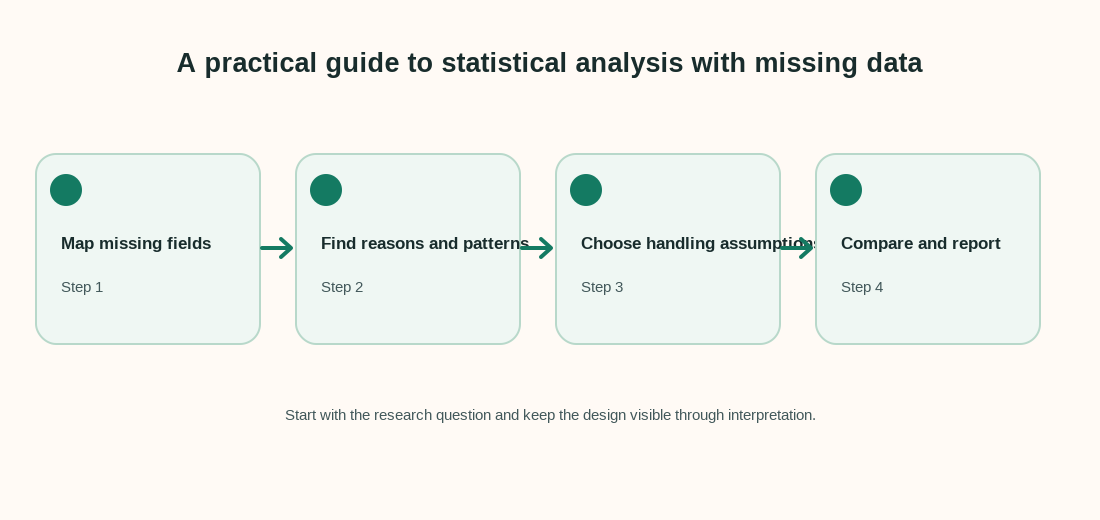
- Count missing values by variable, group and time; keep structural “not applicable” values separate.
- Compare records with and without missing values on observed characteristics.
- Choose complete-case analysis, imputation, weighting or a model-based approach only when its assumptions fit.
- Report how many records were excluded or imputed and run sensitivity checks when conclusions may depend on the choice.
Keep a record of exclusions, recoding decisions and software settings. That makes the analysis easier to check and repeat.
Worked example
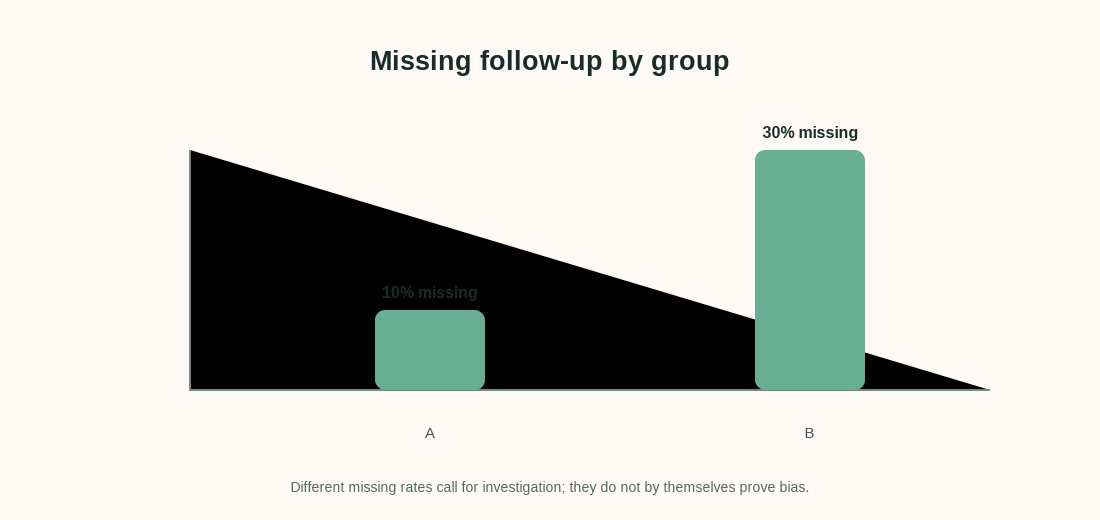
A study has 100 participants, but 20 did not report a follow-up score. The observed counts below show why the missing rate should be reported.
| Group | Enrolled | Follow-up observed | Missing |
|---|---|---|---|
| A | 50 | 45 | 5 |
| B | 50 | 35 | 15 |
Overall, 20 of 100 follow-up scores are missing, or 20%. But the rate is 5/50 = 10% in group A and 15/50 = 30% in group B. An analysis using only observed follow-ups may not represent the groups equally if the missingness is related to outcome or participant characteristics.
Interpret the result carefully
The difference in missing rates is a warning to investigate, not proof of bias. Ask why people in group B missed follow-up and compare observed baseline information before choosing a method.
Limit to keep in mind: No one missing-data procedure is best for all datasets. Imputation does not create information that was never collected and cannot remove bias under every missingness mechanism.
When reporting an analysis, include the sample size, estimate, units and uncertainty. Explain why the method fits the sampling and measurement design. Separate planned tests from exploratory checks, and avoid saying that association proves a cause.
Frequently asked questions
Can I just use complete cases?
Sometimes, under assumptions that should be explained. If missingness relates to the outcome or predictors, complete-case results can be biased or less precise.
Does multiple imputation always fix missing data?
No. Its validity depends on the model, variables included, missingness assumptions and implementation.
Should I replace blanks with zero?
Only when zero is the real measured value. A blank usually represents an unknown or inapplicable value, not a zero.
What should I report?
Give missing counts by key variable and group, explain the handling method and state the assumptions and sensitivity checks.