QUANTITATIVE ANALYSIS · BEGINNER GUIDE
Nominal, Ordinal, Interval and Ratio Data
Classify variables by whether categories have order, equal intervals and a meaningful zero before choosing summaries.
Quick answer: Nominal variables are labels with no order; ordinal variables have order but unknown category spacing; interval scales have equal steps without a meaningful zero; ratio scales have equal steps and a meaningful zero.
What this method answers
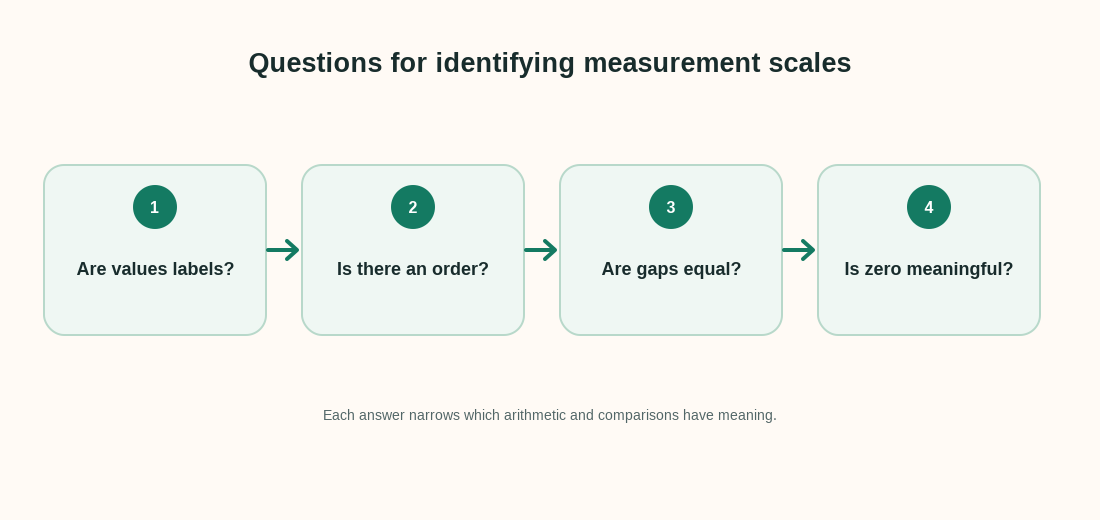
Measurement scale affects which comparisons make sense. A code of 1, 2, 3 for low, medium and high does not guarantee equal gaps. Celsius temperature has equal intervals but zero is not absence of heat; mass in kilograms has a meaningful zero.
Classify each variable before calculating averages or fitting models. A variable’s role and data collection can matter more than the numeric storage type.
Before running a calculation, write down the population and the exact quantity you want to estimate. A method name alone does not define the question, the comparison or the assumptions.
Steps to follow
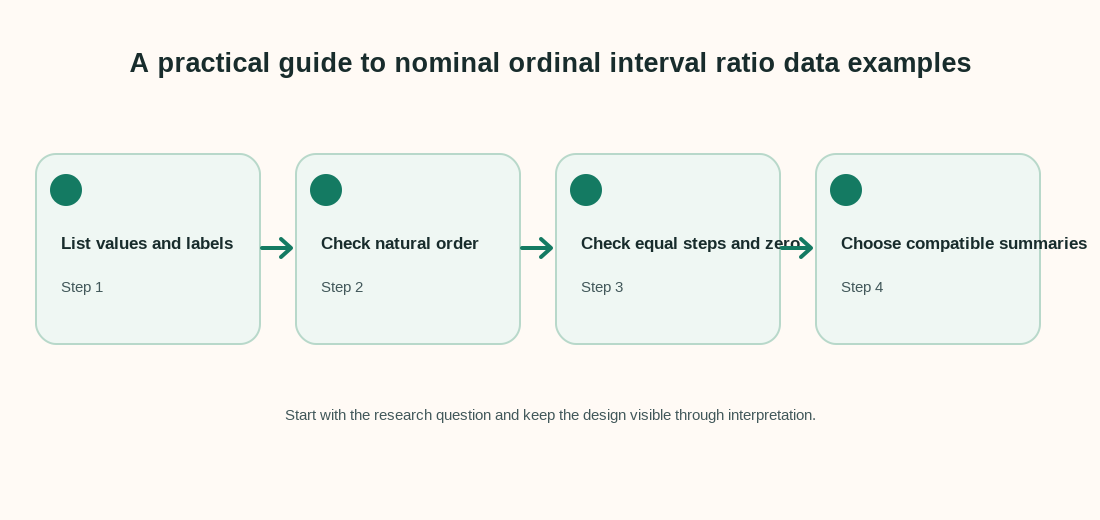
- Read the variable definition and allowed values.
- Ask whether categories have a natural order.
- Ask whether equal differences and a true zero are meaningful.
- Choose summaries and models that preserve the measurement meaning.
Keep a record of exclusions, recoding decisions and software settings. That makes the analysis easier to check and repeat.
Worked example
A survey contains eye color, satisfaction rating, Celsius temperature and waiting time in minutes.
| Variable | Scale | Why |
|---|---|---|
| Eye color | Nominal | Labels, no order |
| Satisfaction 1–5 | Ordinal | Ordered categories; gaps not guaranteed equal |
| Celsius temperature | Interval | Equal steps; zero is arbitrary |
| Wait time | Ratio | Equal steps and meaningful zero |
A mean eye-color code is meaningless if blue=1, green=2 and brown=3; changing those codes changes the mean without changing anyone’s color. Counts and proportions preserve the category meaning.
Interpret the result carefully
Ordinal data can be summarized with category counts, cumulative percentages and sometimes medians. Numeric models may be appropriate when coding assumptions are justified and explained.
Limit to keep in mind: Scale labels do not decide every analysis. Study design, distribution, estimand and model assumptions also matter.
When reporting an analysis, include the sample size, estimate, units and uncertainty. Explain why the method fits the sampling and measurement design. Separate planned tests from exploratory checks, and avoid saying that association proves a cause.
Frequently asked questions
Is a 1–5 rating always interval?
Not automatically; one item is usually ordinal unless equal spacing is justified.
Can nominal categories have numbers?
Yes, but the numbers are identifiers rather than quantities.
What is a ratio scale?
A scale with equal intervals and a meaningful zero, allowing ratios such as twice as long.
Does scale alone select the test?
No. Design, distribution and research question matter too.