STATISTICAL ANALYSIS · BEGINNER GUIDE
MCAR, MAR and MNAR: Three Missing-Data Patterns
Compare missing completely at random, at random given observed data and not at random with simple survey examples.
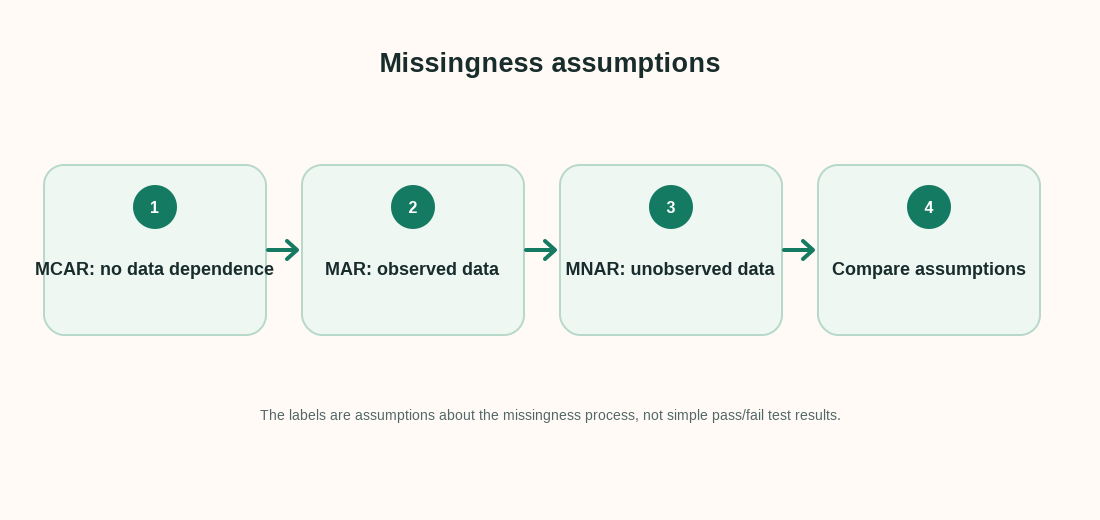
Quick answer: MCAR means missingness is unrelated to observed or missing values. MAR means it can depend on observed information after conditioning on it. MNAR means it still depends on the unobserved value or another unobserved factor.
What this method answers
These labels describe assumptions about why data are missing, not tests that a dataset can conclusively pass. MAR is not “missing values look random”; it is conditional on observed data included in the model.
Use the distinctions to plan analysis and sensitivity checks. The mechanism is rarely known with certainty, so use study knowledge and compare plausible assumptions.
Before running a calculation, write down the population and the exact quantity you want to estimate. A method name alone does not define the question, the comparison or the assumptions.
Steps to follow
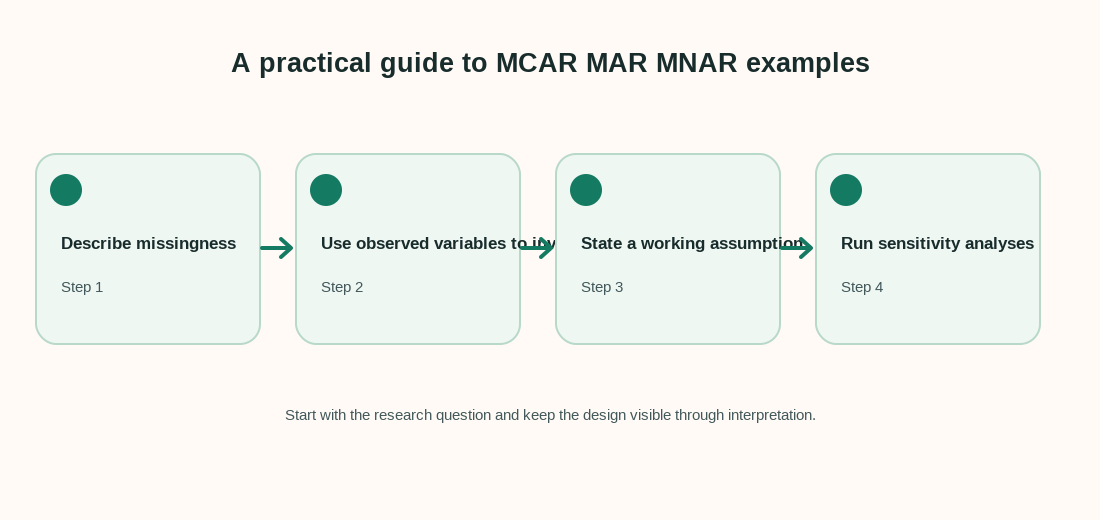
- Report missing counts and patterns for every important variable.
- Check whether observed characteristics predict missingness.
- Choose a method under explicit assumptions rather than naming a mechanism as fact.
- Compare conclusions under plausible missing-not-at-random scenarios.
Keep a record of exclusions, recoding decisions and software settings. That makes the analysis easier to check and repeat.
Worked example
Some survey income values are blank. A random form-printing error may resemble MCAR; response rates differing by observed age may be MAR after age is modeled; very high incomes being withheld may be MNAR.
| Pattern | Missingness depends on | Possible example |
|---|---|---|
| MCAR | Neither observed nor missing values | Random file corruption |
| MAR | Observed variables | Age group predicts item response |
| MNAR | Unobserved value or factor | Income level affects willingness to disclose |
A missingness rate of 20% does not identify the mechanism. Compare response patterns by observed variables, but remember that these checks cannot prove missingness is MAR rather than MNAR.
Interpret the result carefully
Under MCAR, complete cases may remain representative for some analyses but lose precision. Under MAR, modeled imputation or likelihood methods can help. MNAR needs sensitivity analysis or additional information.
Limit to keep in mind: No statistical test using only observed data can generally distinguish MAR from MNAR without extra assumptions or follow-up information.
When reporting an analysis, include the sample size, estimate, units and uncertainty. Explain why the method fits the sampling and measurement design. Separate planned tests from exploratory checks, and avoid saying that association proves a cause.
Frequently asked questions
Can data prove MAR?
Usually not from observed values alone; it is a working assumption.
Is MCAR the same as MAR?
MCAR is a special, stronger case that does not depend on observed or missing values.
Can mean imputation solve MNAR?
No. It hides uncertainty and does not model why values are missing.
What helps assess MNAR?
Follow-up information, subject knowledge and sensitivity analysis can show how conclusions might change.