STATISTICAL ANALYSIS · BEGINNER GUIDE
ANOVA with Unequal Sample Sizes: What to Check
Learn why unequal group sizes affect ANOVA interpretation and which design details to report before comparing means.
Quick answer: Unequal group sizes do not automatically prevent ANOVA. They do make the design and variance assumptions more important, especially when group sizes and variances differ together.
What this method answers
A one-way ANOVA can estimate group means from groups with different numbers of observations. The total sample size is the sum of the group sizes, and the standard errors depend on both sample size and variability.
In multi-factor designs, unbalanced cells can make “main effect” tests depend on how terms are defined and tested. Report the model formula and software convention instead of assuming every ANOVA table answers the same question.
Before running a calculation, write down the population and the exact quantity you want to estimate. A method name alone does not define the question, the comparison or the assumptions.
Steps to follow
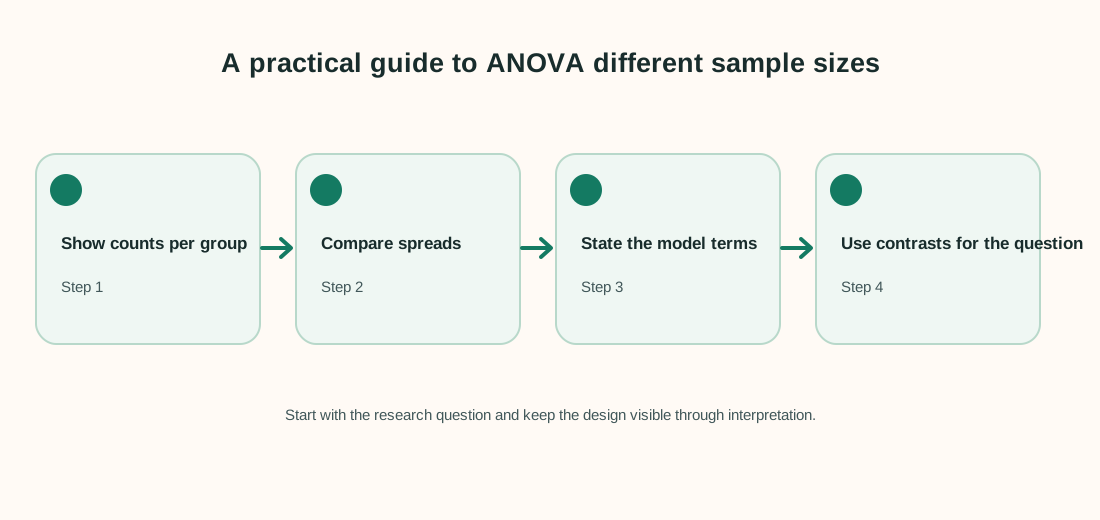
- Tabulate the number of valid observations in every group or factor combination.
- Plot the outcome by group and compare spread, not just the mean.
- Check whether missingness or exclusions explain the imbalance.
- State the model terms, contrast coding and sums-of-squares method used.
Keep a record of exclusions, recoding decisions and software settings. That makes the analysis easier to check and repeat.
Worked example
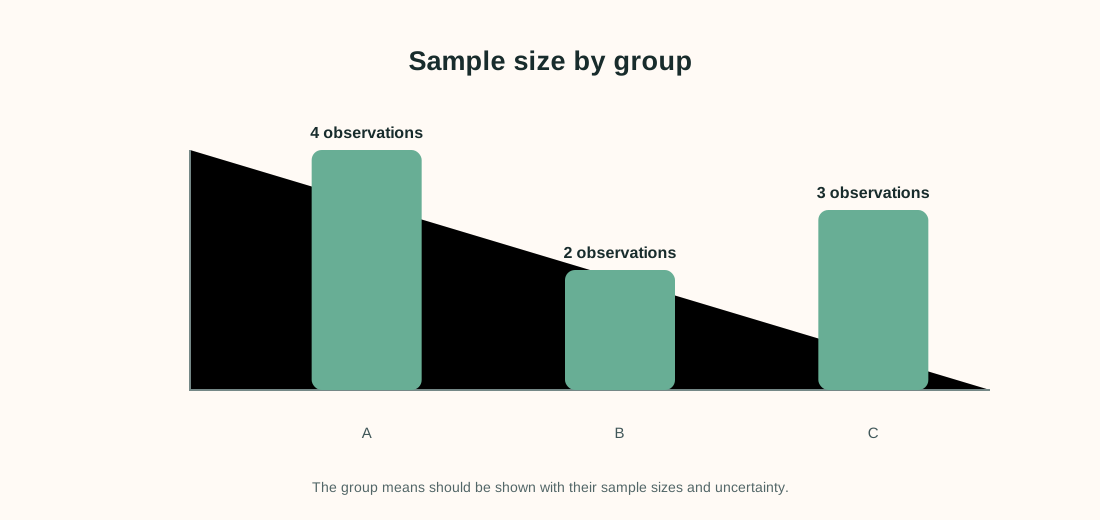
Suppose three training groups have different numbers of participants. These made-up scores show why group count belongs beside every mean.
| Group | Scores | n | Mean |
|---|---|---|---|
| A | 6, 7, 8, 9 | 4 | 7.5 |
| B | 7, 8 | 2 | 7.5 |
| C | 8, 9, 10 | 3 | 9.0 |
Groups A and B have the same mean, but A’s estimate uses four scores and B’s uses two. The means alone hide that difference in precision. Group C is higher by 1.5 points in this sample; uncertainty and the reason for the different counts still matter.
Interpret the result carefully
Unequal counts often arise from planned allocation, dropout or missing measurements. Those causes have different implications, so explain which occurred and whether the missing data could be related to outcomes.
Limit to keep in mind: Do not rebalance by discarding observations without a design-based reason. Deleting valid data can waste information and create new bias.
When reporting an analysis, include the sample size, estimate, units and uncertainty. Explain why the method fits the sampling and measurement design. Separate planned tests from exploratory checks, and avoid saying that association proves a cause.
Frequently asked questions
Can I use ordinary one-way ANOVA with unequal group sizes?
It can be appropriate under its model assumptions. Consider unequal variances and explain the design.
Do unequal counts always bias the means?
Not automatically. Bias depends on how observations entered or left the data and how the outcome relates to missingness.
What changes in a factorial ANOVA?
Unbalanced cells can make term tests and averaged effects depend on the parameterization and sums-of-squares convention.
Should I use Type III sums of squares?
There is no universal rule. Match the tested contrasts to the research question and report the model and coding.