STATISTICAL RESEARCH · BEGINNER GUIDE
Stratified vs Cluster Sampling: A Practical Difference
Tell strata from clusters and see how the two designs select people differently.
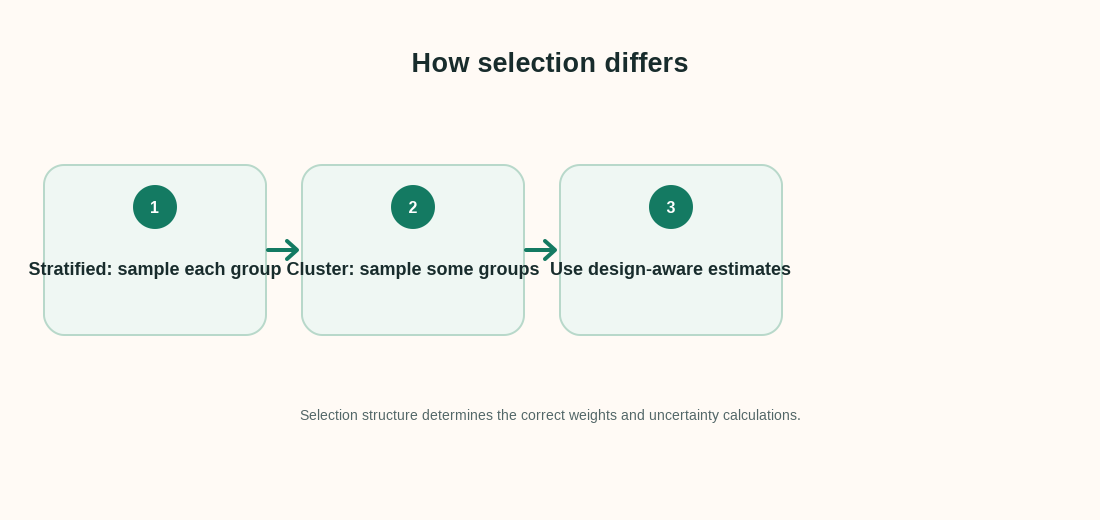
Quick answer: Stratified sampling divides a population into strata and samples from every stratum. Cluster sampling divides it into clusters, samples some clusters and then surveys units within selected clusters.
What this method answers
Strata are often formed to ensure representation and improve precision. Clusters are often natural groups such as schools or neighbourhoods that reduce field cost; people within a cluster may resemble one another, which affects variance.
Choose based on the population structure, field constraints and target precision. Sampling a few schools is not equivalent to sampling a few students from every school.
Before running a calculation, write down the population and the exact quantity you want to estimate. A method name alone does not define the question, the comparison or the assumptions.
Steps to follow
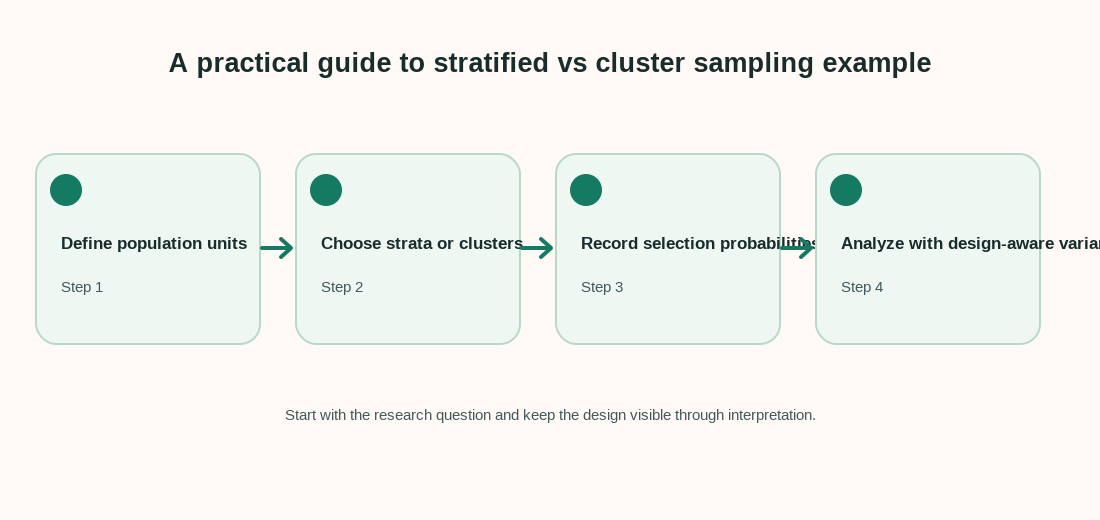
- Map natural population groups and the target subgroups.
- Decide whether to sample from every stratum or select some clusters.
- Record selection probabilities at each sampling stage.
- Use weights and variance estimation that reflect the actual design.
Keep a record of exclusions, recoding decisions and software settings. That makes the analysis easier to check and repeat.
Worked example
A city has 10 schools, each with 100 students. A stratified design samples 10 students from each school; a cluster design selects two schools and surveys all 100 students in them.
| Design | Selected units | Total respondents |
|---|---|---|
| Stratified | 10 students in each of 10 schools | 100 |
| Cluster | All students in 2 selected schools | 200 |
The respondent counts differ in this illustration, but the key distinction is what gets sampled. Clustered responses may have a design effect greater than one, so 200 students from two schools can contain less information than 200 spread widely.
Interpret the result carefully
The design determines inclusion probabilities and standard errors. Population estimates need weights and variance methods that match how schools and students were selected.
Limit to keep in mind: Ignoring clustering usually understates uncertainty when units within a school are similar. More respondents inside few clusters do not always replace sampling more clusters.
When reporting an analysis, include the sample size, estimate, units and uncertainty. Explain why the method fits the sampling and measurement design. Separate planned tests from exploratory checks, and avoid saying that association proves a cause.
Frequently asked questions
Are schools strata or clusters?
They can be either depending on how selection works: sample within every school for stratification, or select some schools as clusters.
Why can cluster sampling be less precise?
People within a cluster may share characteristics, so their responses provide less independent information.
Can I ignore weights?
Not if unequal selection probabilities or nonresponse adjustments are part of the design.
Does a larger cluster sample always help?
It adds respondents but may give less information than adding independent clusters.