STATISTICAL RESEARCH · BEGINNER GUIDE
Statistical Analysis in Clinical Trials: What the Plan Should Say
Understand the role of a prespecified analysis plan, endpoints, populations, missing data and uncertainty in clinical-trial reporting.
Quick answer: A clinical-trial analysis plan should specify the primary question, outcome, analysis population, model, missing-data approach and handling of multiple comparisons before outcomes are examined. This reduces selective analysis and makes results easier to interpret.
What this method answers
A trial can collect many outcomes and follow participants at several times. If analysts choose the most favorable outcome or time point after seeing results, reported evidence can be misleading.
The protocol and statistical analysis plan should define how treatment effects will be estimated and what sensitivity analyses will test. Reporting should include effect sizes and confidence intervals, not only whether a p-value crossed a threshold.
Before running a calculation, write down the population and the exact quantity you want to estimate. A method name alone does not define the question, the comparison or the assumptions.
Steps to follow
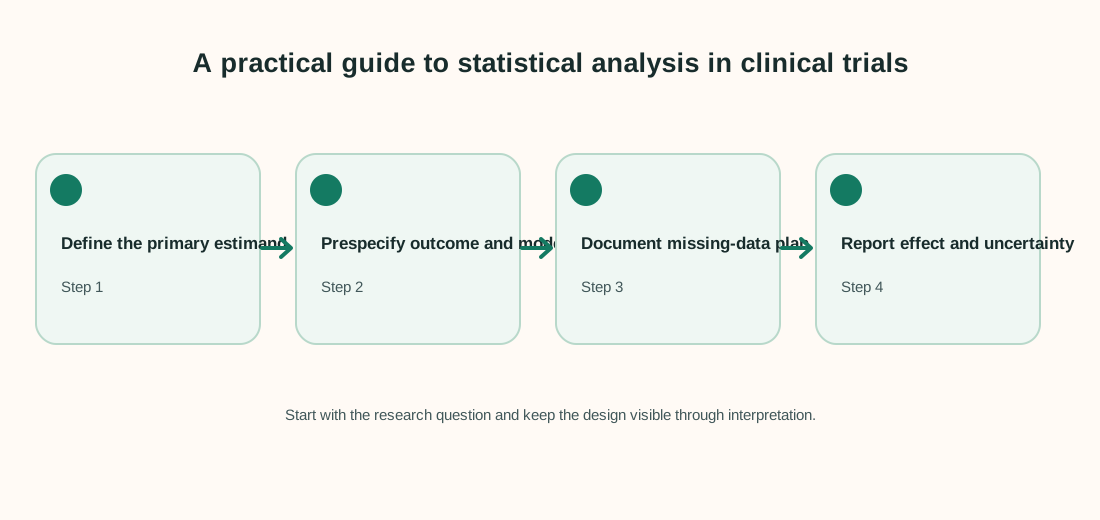
- State the primary outcome, time point and treatment comparison.
- Define the analysis population and how intercurrent events will be handled.
- Prespecify the model, covariates, missing-data strategy and multiplicity plan.
- Report participant flow, effect estimates, uncertainty and deviations from the plan.
Keep a record of exclusions, recoding decisions and software settings. That makes the analysis easier to check and repeat.
Worked example
A fictional trial compares a new program with usual care on a 12-week symptom score. The numbers below are an analysis-plan checklist, not trial results.
| Plan element | Example choice |
|---|---|
| Primary outcome | Symptom score at week 12 |
| Primary comparison | Program vs usual care |
| Main estimate | Adjusted mean difference |
| Missing-data check | Prespecified sensitivity analysis |
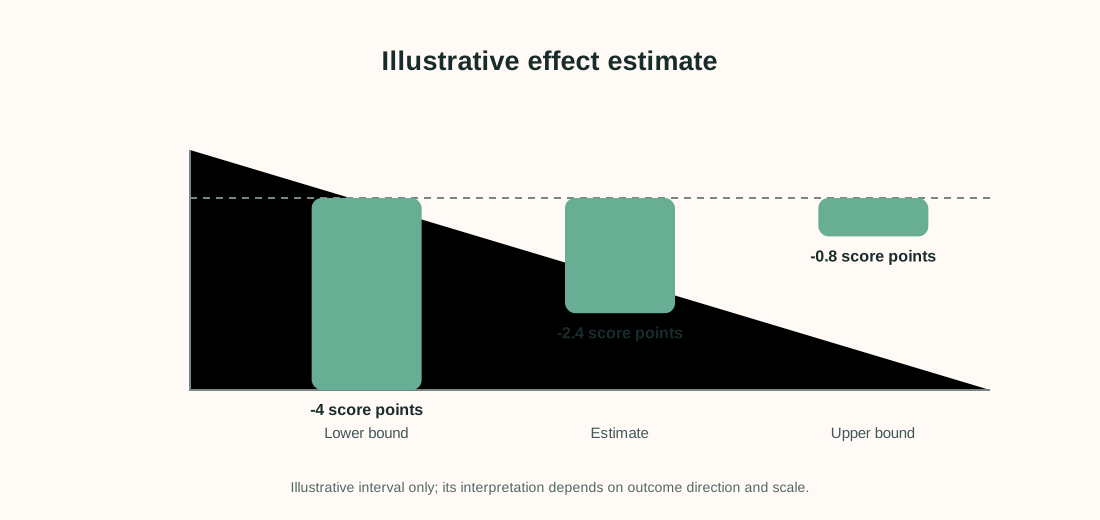
If the adjusted mean difference were −2.4 points with a 95% confidence interval from −4.0 to −0.8, the estimate would favor a lower symptom score in the program group, assuming lower scores indicate improvement. The interval describes uncertainty under the model; practical importance depends on a clinically meaningful scale difference.
Interpret the result carefully
The example shows why direction and score meaning must be stated. A statistically detectable difference may still be too small to matter to patients, and a wide interval may leave important effects uncertain.
Limit to keep in mind: This guide is a statistical overview, not a substitute for trial regulations, protocol review or clinical expertise. The appropriate analysis depends on the trial design and estimand.
When reporting an analysis, include the sample size, estimate, units and uncertainty. Explain why the method fits the sampling and measurement design. Separate planned tests from exploratory checks, and avoid saying that association proves a cause.
Frequently asked questions
Why prespecify an analysis plan?
It documents decisions before outcome results can influence them and lets readers compare planned and reported analyses.
Does a confidence interval show clinical importance?
No. Compare the estimated effect with a meaningful threshold for the outcome and patient context.
Can I change the plan after seeing data?
Changes may be necessary, but label and explain them transparently and distinguish planned from exploratory analyses.
What does intention-to-treat mean?
It is a principle for analyzing participants according to assigned groups; the exact estimand and handling of intercurrent events should be clearly specified.