STATISTICAL RESEARCH · BEGINNER GUIDE
Sample Size for Power vs Sample Size for Precision
Choose whether a sample-size calculation should target a chance of detecting an effect or a desired interval width.
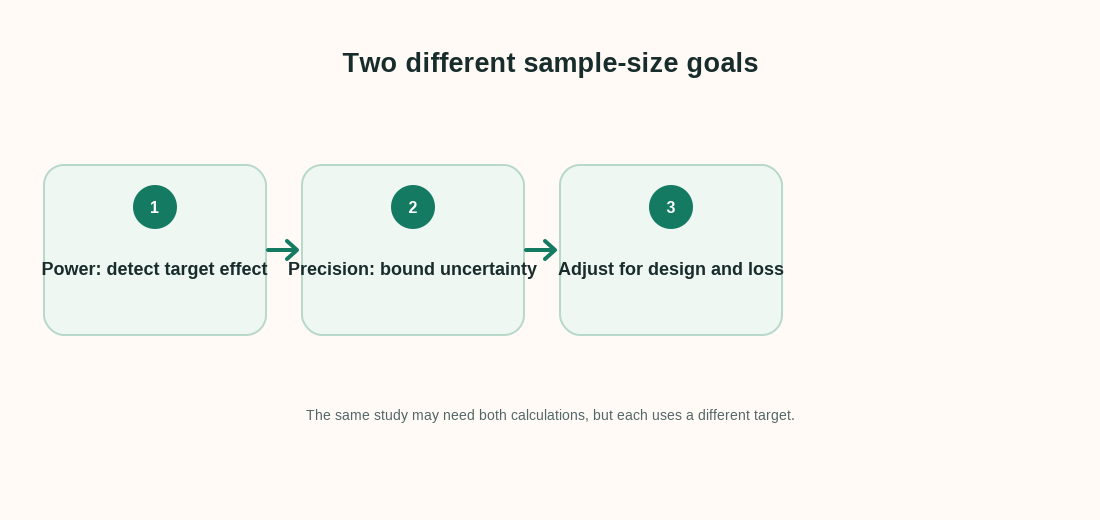
Quick answer: A power-based sample size is designed around a specified effect, significance level and probability of detection. A precision-based size aims for an estimate with a chosen margin of error or confidence-interval width.
What this method answers
The two calculations answer different planning questions. Power needs an effect size worth detecting; precision needs a target uncertainty and often a prevalence or variance estimate. Both require assumptions that should be justified before data collection.
Use power planning for a planned hypothesis test and precision planning for estimation-focused studies such as prevalence surveys.
Before running a calculation, write down the population and the exact quantity you want to estimate. A method name alone does not define the question, the comparison or the assumptions.
Steps to follow
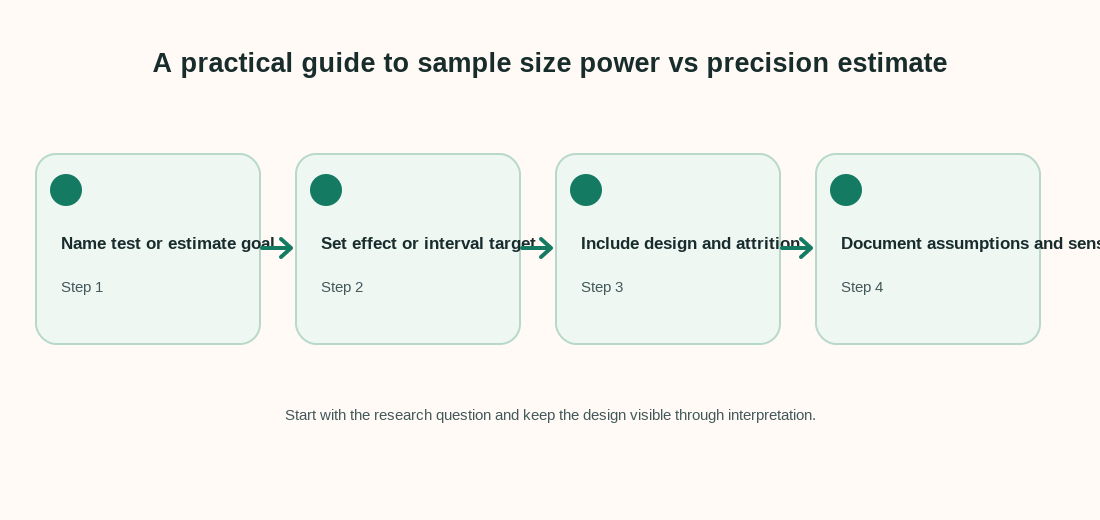
- Define: Name test or estimate goal.
- Check: Set effect or interval target.
- Calculate or compare: Include design and attrition.
- Report: Document assumptions and sensitivity.
Keep a record of exclusions, recoding decisions and software settings. That makes the analysis easier to check and repeat.
Worked example
A survey team wants a proportion estimate within ±5 percentage points, while a trial team wants 80% power for a prespecified mean difference.
| Planning target | Inputs to specify | Output |
|---|---|---|
| Power | Effect, alpha, variability, design | Required sample for detection goal |
| Precision | Confidence level, margin, variability | Required sample for interval-width goal |
For a simple proportion near 0.50, a 95% margin of about 0.05 requires roughly n=1.96²×0.5×0.5/0.05²≈385 independent observations before nonresponse and design adjustments.
Interpret the result carefully
The estimate is an approximation under simple random sampling. Cluster design, finite populations, nonresponse and the primary analysis can change the required recruitment target.
Limit to keep in mind: A sample-size calculation cannot guarantee a significant result or narrow interval if assumptions are wrong, data are missing or the observed effect differs from the planning value.
When reporting an analysis, include the sample size, estimate, units and uncertainty. Explain why the method fits the sampling and measurement design. Separate planned tests from exploratory checks, and avoid saying that association proves a cause.
Frequently asked questions
What is the main idea behind power and precision sample-size planning?
A power-based sample size is designed around a specified effect, significance level and probability of detection. A precision-based size aims for an estimate with a chosen margin of error or confidence-interval width.
When should I use it?
Use power planning for a planned hypothesis test and precision planning for estimation-focused studies such as prevalence surveys.
What mistake should I avoid?
Choosing a sample size from a generic online calculator without specifying the estimand, design, expected effect or attrition.
What should I report?
State the study question, analyzed sample, method, estimate, units and uncertainty. Include assumptions and any exclusions that affect interpretation.