STATISTICAL METHODS · BEGINNER GUIDE
Regression Through the Origin: When Is It Appropriate?
Understand the strong zero-intercept assumption and why forcing a line through zero can distort slopes.
Quick answer: A regression through the origin fixes the intercept at zero, asserting that the expected outcome is exactly zero when every predictor is zero. This may be justified by physics or design, but should not be imposed just to simplify a graph.
What this method answers
Removing an intercept changes the least-squares solution and usually changes slope estimates and R-squared definitions. Residuals no longer necessarily sum to zero, and standard summaries may have different meanings.
Use a zero-intercept model only when the zero relationship is substantively required and the data support the model near zero. Compare residuals and predictions with an intercept model as a sensitivity check.
Before running a calculation, write down the population and the exact quantity you want to estimate. A method name alone does not define the question, the comparison or the assumptions.
Steps to follow
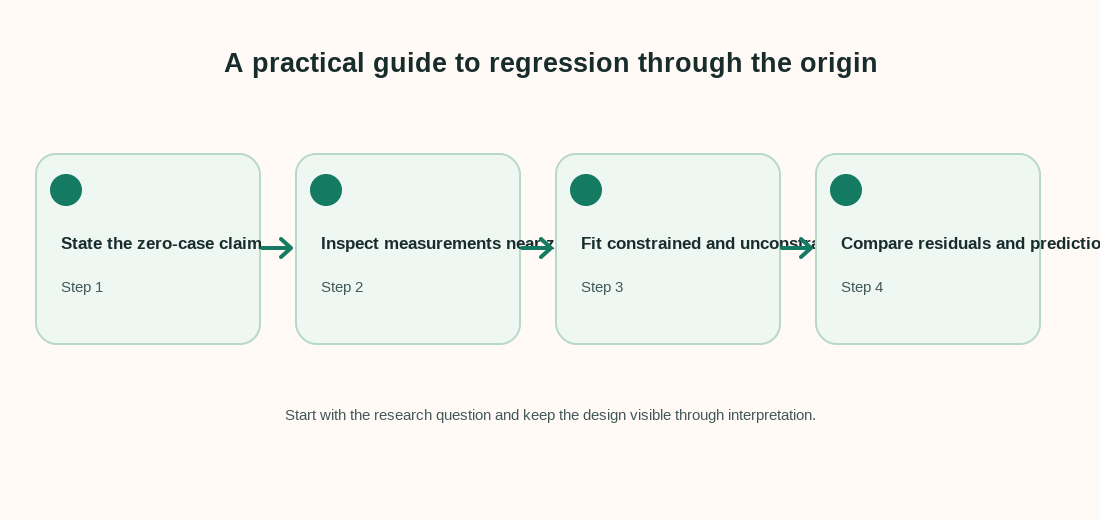
- Write the scientific reason the intercept should be exactly zero.
- Check calibration and observed data near the zero point.
- Fit both constrained and ordinary intercept models.
- Compare slopes, residual patterns and predictions over the intended range.
Keep a record of exclusions, recoding decisions and software settings. That makes the analysis easier to check and repeat.
Worked example
A calibration experiment measures known concentration x and sensor response y. A response of zero at concentration zero is theoretically expected, but baseline offset may exist in the instrument.
| Concentration x | Observed response y |
|---|---|
| 0 | 2 |
| 1 | 4 |
| 2 | 6 |
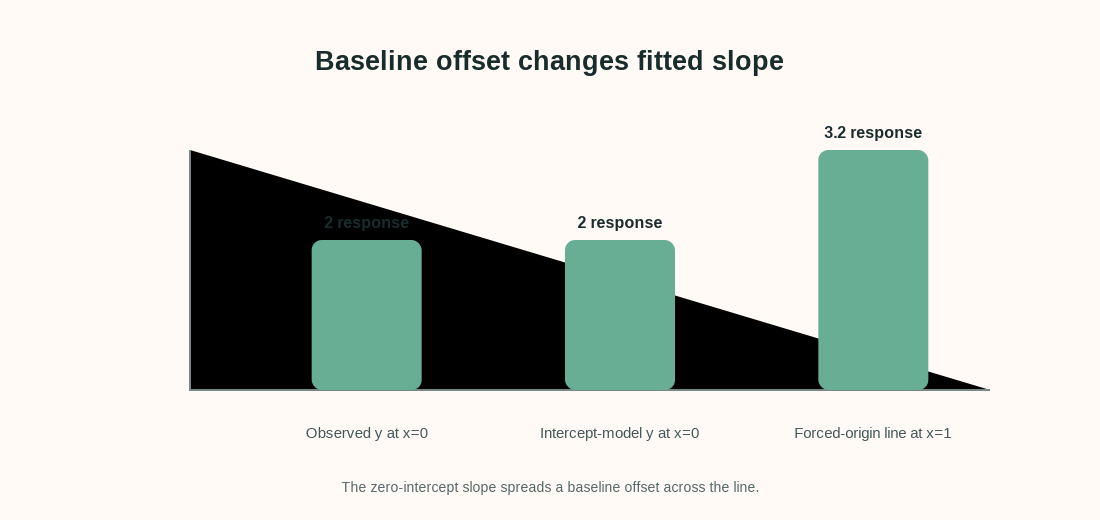
An intercept model fits y=2+2x exactly. A forced-origin least-squares line has slope (0×2+1×4+2×6)/(0²+1²+2²)=16/5=3.2, showing how the baseline offset changes the slope.
Interpret the result carefully
The forced model predicts 3.2 at x=1 versus 4 under the intercept model. If a baseline offset is real, forcing zero spreads that error across the slope.
Limit to keep in mind: A theoretical zero constraint may be appropriate, but a small observed range near zero makes it difficult to verify. Measurement background and calibration procedures matter.
When reporting an analysis, include the sample size, estimate, units and uncertainty. Explain why the method fits the sampling and measurement design. Separate planned tests from exploratory checks, and avoid saying that association proves a cause.
Frequently asked questions
Does regression normally include an intercept?
Usually yes, unless a justified model constraint sets it to zero.
Can forcing the origin change slope?
Yes, as the example shows, especially when a baseline offset exists.
Does R² have its usual interpretation without an intercept?
Some software uses a different uncentered definition; interpret it carefully.
Can I decide from a scatterplot alone?
A plot helps, but domain knowledge and measurement design are needed to justify the exact zero constraint.