CLASSIFICATION · BEGINNER GUIDE
Multinomial vs Ordinal Logistic Regression
Choose a model for unordered categories or ordered ratings by checking whether category order carries meaning.
Quick answer: Multinomial logistic regression models outcomes with three or more categories that have no natural order. Ordinal logistic regression uses an order, such as low, medium and high, and can share information across cumulative thresholds under its assumptions.
What this method answers
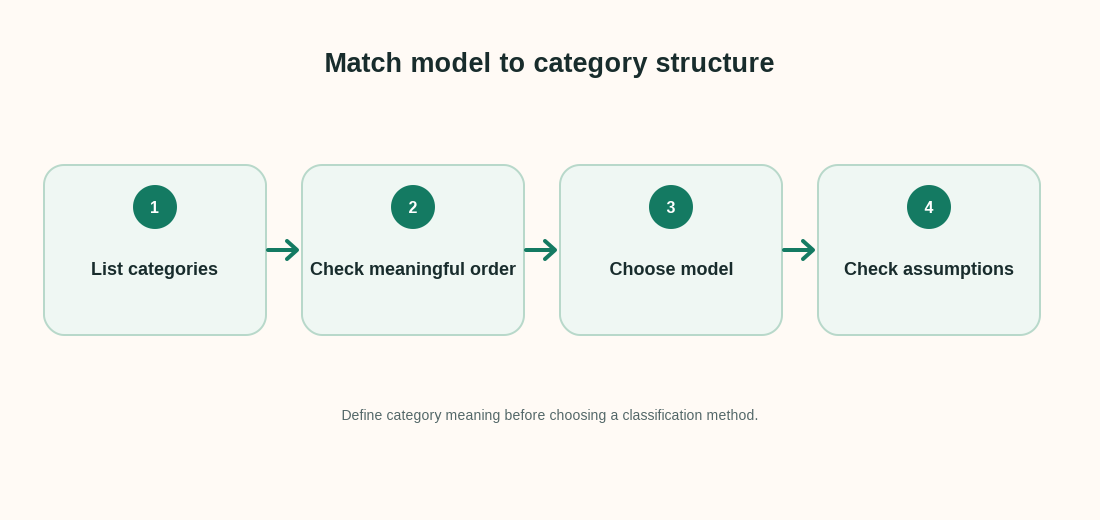
Treating an ordered rating as unordered discards ranking. Treating unordered labels as ordered invents a ranking. The model should match how categories are defined and how predictions will be used.
Use multinomial models for labels like bus, train and bicycle. Consider ordinal models for ratings, after checking assumptions such as proportional odds.
Before running a calculation, write down the population and the exact quantity you want to estimate. A method name alone does not define the question, the comparison or the assumptions.
Steps to follow
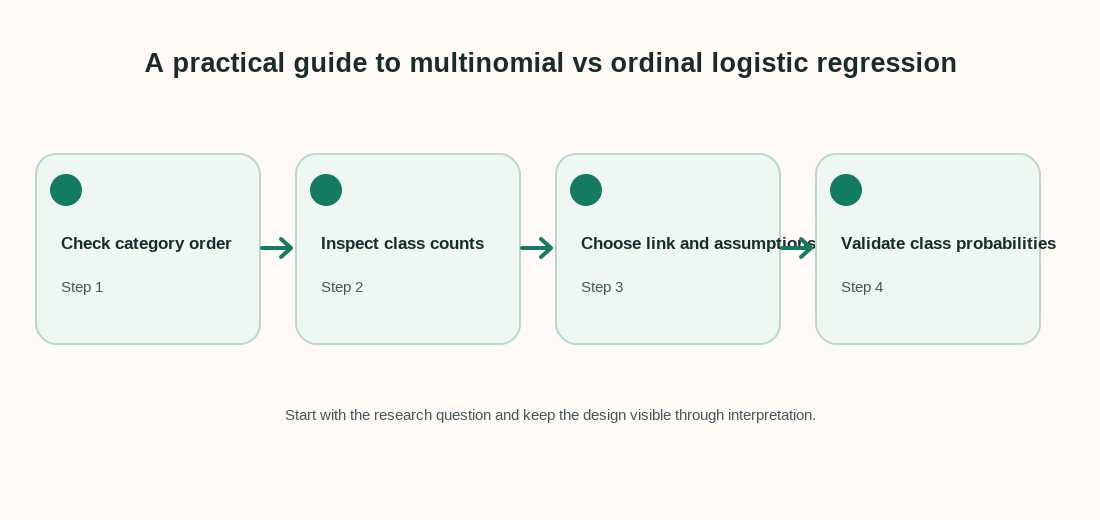
- Decide whether category order is meaningful before encoding.
- Check category frequencies and sparse levels.
- Fit a model whose link and assumptions match the outcome.
- Report category-specific predictions and validate calibration.
Keep a record of exclusions, recoding decisions and software settings. That makes the analysis easier to check and repeat.
Worked example
A survey predicts satisfaction from wait time. Categories are poor, fair, good and excellent.
| Outcome type | Example labels | Model to consider |
|---|---|---|
| Unordered | Bus, train, bicycle | Multinomial logistic |
| Ordered | Poor, fair, good, excellent | Ordinal logistic |
An ordinal model may estimate how wait time changes cumulative odds of reaching or exceeding each satisfaction level. The coefficient direction depends on category order and software convention.
Interpret the result carefully
State the outcome order and coefficient coding. A positive coefficient is not automatically better unless the scale direction is clear.
Limit to keep in mind: Ordinal assumptions may fail and categories may be sparse. Check calibration and per-class performance, not only accuracy.
When reporting an analysis, include the sample size, estimate, units and uncertainty. Explain why the method fits the sampling and measurement design. Separate planned tests from exploratory checks, and avoid saying that association proves a cause.
Frequently asked questions
Can multinomial logistic handle ordinal data?
Yes, but it ignores order and may use more parameters.
Does ordinal regression assume equal category gaps?
No. It uses order, though common models impose other assumptions.
What if proportional odds fails?
Consider a partial proportional-odds or multinomial alternative if supported.
Should rare categories be merged?
Only when substantively defensible; merging changes the outcome definition.